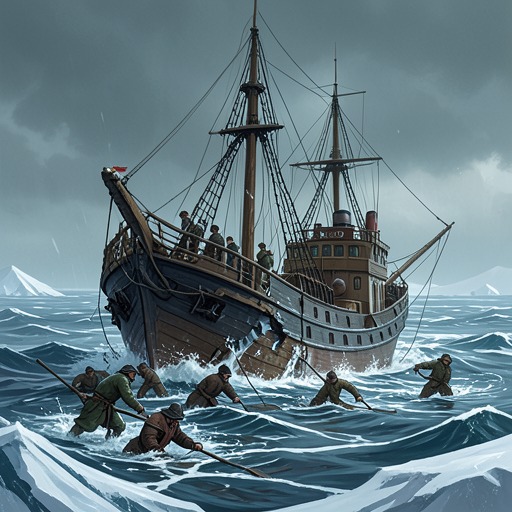
Volunteer deliberately scuttled in Lancaster Sound
The North WaterThe deliberate scuttling of the Volunteer in Lancaster Sound converts an attempted insurance deception into a genuine maritime disaster. Cavendish first expects the ice to destroy the ship and provide a plausible account of its loss; when the hull proves more resilient than he anticipated, he takes an axe to its timbers. The sequence exposes the gap between a staged accident and the deliberate act required to make that accident real, while placing the crew’s labor and survival inside a scheme organized around financial gain.
Commercial Scheme and Its Cover
The plot grows out of a voyage in which whaling is both the public purpose and, for the conspirators, a lesser source of profit. Years earlier, Baxter had warned Brownlee that the industry had changed: modern whaling demanded costly steam power and specialized weapons, and even a well-equipped ship might return without a catch. Brownlee nevertheless insisted he could fill the hold. In a separate conversation, Baxter produced papers and emphasized that twelve thousand pounds divided three ways would exceed what Brownlee could expect to earn from whales. He described money as a force that followed its own course, an explanation that makes commercial pressure sound inevitable even as he participates in a particular arrangement.
The voyage does yield catches. After the Volunteer sails north from Lerwick, the crew prepares rifles and knives for sealing, and five whaleboats return laden with skins. Later, Brownlee estimates that a whale will provide ten tons of oil and at least half a ton of whalebone, worth close to nine hundred pounds if market prices hold. Those working returns establish the contrast at the heart of the scheme: hunting and processing animals require coordinated, dangerous labor, while the planned sinking promises a much larger financial return. Sumner, otherwise unoccupied, is assigned to carry heavy blocks of blubber from the deck into the hold; his work makes the ship’s ordinary commercial purpose tangible even as others prepare its destruction.
The insurance deception depends on appearance as well as loss. Campbell warns that the whales are a relatively small part of the plan and that an opportunity to sink the ship convincingly may not come again. The timing must avoid suspicion from the underwriters; Campbell also fears being trapped if the ship waits too long. Earlier, the crew had been told that Campbell was waiting somewhere ahead in the Hastings, though the vessels would not meet or communicate until the moment was right. The voyage therefore carries a concealed second itinerary: the visible work of whaling, and a planned loss whose circumstances must look credible to those assessing the claim.
Ice, Preparation, and Failed Expectation
When the wind shifts from south to north, loose drift ice begins moving toward the Volunteer. Cavendish orders the crew to cut an ice dock into the land floe for protection. The operation requires ice saws, gunpowder, ropes, and poles. Black marks out the dock, and the men work in teams with long saws suspended from wooden tripods. They cut through ice six feet thick to make sides two hundred feet long, then divide the floe into sections. This strenuous communal work temporarily gives the crew a practical defense against the advancing pack, but the same setting becomes a potential instrument in the plan to lose the ship.
Cavendish initially treats the pressure of the ice as an adequate means of destruction. He says that if the Volunteer does not sink at once, he can sink it later. Drax observes that a later sinking will not look as convincing, and the two discuss the crew’s position on the fast ice: Campbell could warp back if a lead opened, while the other men believe the ship has already been stove in and are unlikely to interfere. Cavendish insists the ship will not survive the pressure. Drax counters that the ship can survive if Cavendish allows it to, and offers to damage it directly with an axe. The exchange makes the central problem plain: the conspirators need not merely a wreck, but a wreck that can pass as the consequence of ice.
Deliberate Damage and the Ship’s Loss
Cavendish and Drax go below with a lantern and an axe to inspect the forehold. They move casks aside and find water entering through a breach where the timbers have separated and the caulking has fallen away, but there is no evidence of serious damage. The discovery overturns Cavendish’s expectation that the ice has already done the work. Drax explains that the ship bent without breaking and tells Cavendish that it will not sink unless he makes it do so. Cavendish reaches for the axe.
After a brief confrontation, Cavendish turns away and strikes the already dampened timbers repeatedly. The ship begins to take on the damage that the ice alone had failed to inflict. Within two hours, the Volunteer has pitched forward until its bowsprit lies against the ice, and its foremast has broken. Cavendish sends Black aboard with a team to salvage the booms, spars, and rigging and to cut down the remaining masts before they also break away. With the masts removed and only the stern visible above the surrounding ice, the vessel has been reduced from a working ship to a wrecked remnant. Sumner, contemplating it afterward, questions how he had ever trusted a structure of wood, nails, and rope to keep him safe.
Exposure and Significance
The sinking’s staged appearance does not erase its deliberate cause. The ice provides a plausible setting, but the discovery of limited damage in the hold and Cavendish’s axe blows show that the ship’s destruction required human action. Campbell’s warning about appearances and the underwriters gives that action its commercial context: the conspirators are managing not only the loss but the story that will account for it. The attempt to make fraud resemble accident thus depends on controlling evidence, timing, and the movements of the people who might know what happened.
Later, Sumner states his understanding of the scheme to Baxter: he accuses Baxter of having Cavendish sink the Volunteer and describes an intended chain in which Drax would shoot him and Stevens would then shoot Drax, leaving the witnesses dead. Baxter denies the account and turns the conversation toward the two men dead in the timber yard, one of whom Sumner killed. The accusation does not undo the ship’s loss, but it reframes it as part of a larger plan and identifies Baxter as a participant whom Sumner believes responsible. The event’s decisive reversal is therefore double: the Volunteer survives the ice that was meant to destroy it, only to be deliberately damaged, and the supposed maritime accident later becomes evidence in the conflict over who profited and who would be left to answer for the deaths.